What happens when the courts are renovated
Why Queensland clubs close their courts each spring, what each job does for play, and how long and how hard each one is.
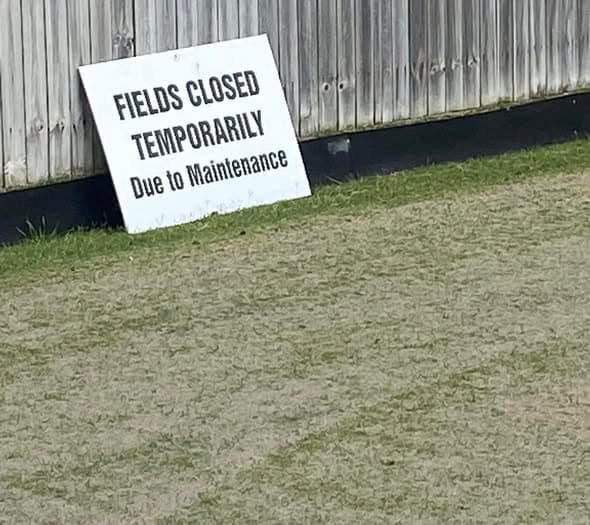
Many Queensland croquet clubs close their courts for a few weeks each spring so the grass and soil can be renovated. When play returns, the courts look and play a little differently. The work clears out dead grass, loosens packed soil and smooths out bumps, so the ball runs faster and truer.
Over a year, three things go wrong with a court.
First, thatch. Couch grass builds a spongy mat of dead stems, runners and roots between the green leaf and the soil. A little is fine. Past about 10 to 15mm it stops water and food reaching the roots, and the surface turns soft. A firm surface makes a fast court. A spongy one makes a slow court.
Second, compaction. Feet, mowers and rain pack the soil down. Roots stay shallow, water sits on top, and the grass thins in the busy lanes. As Wynnum explained after heavy rain, "When the ground is saturated, every footstep presses water and air out of the soil."

Wynnum: puddles lying across a waterlogged court after heavy rain, May 2026 (Wynnum Croquet Club)
Third, humps and dips. A croquet ball finds every one, wobbling off line or slowing down.
Queensland courts are couch grass, which grows fastest in late spring and early summer, so it heals fastest then. Clubs wait until the grass is growing strongly. October to November suits the heavy scarify: after winter, before wet-season fungus peaks.
Scalping
The court is mown right down to the thatch with the club mower on its lowest setting, usually by the greenkeeper or volunteers. This lets the next machine reach the layer underneath. Couch regrows from its runners, so the brown, stripy look afterwards is normal.
Scarifying
A machine with spinning upright blades slices into the turf and rips out the thatch. The surface firms up and plays faster, and water reaches the roots. A great deal comes out: Toombul lifted 300kg from one lawn and 250kg from another in a day. The machine is quick, but raking up and carting away the thatch is the heavy part, and that is where volunteers come in.
Some clubs hire a contractor for the whole job.

Windsor: a walk-behind scarifier beside the brown strip it has just scarified, August 2026 (Windsor Croquet Club)

Toombul: bags of thatch raked off a freshly scarified lawn, December 2020 (Toombul Croquet Club)
Coring
A machine drives hollow tubes into the soil and lifts out plugs. The holes are roughly 10 to 20mm across and 75 to 150mm deep, depending on the machine. Air, water and roots get down, so the court drains and the grass holds up in the busy lanes.
It is usually contractor work. Windsor's coring took about a week.

Eildon: core holes and soil plugs along a strip of court, 2026 (Eildon Croquet Club)
Top-dressing
A thin layer of sand is spread and brushed into the grass and holes, by a towed hopper or by shovel and barrow. It fills holes and smooths small dips. It takes a lot of sand: in early 2023, when sand was hard to get, Toombul's contractor found 20 cubic metres for its lawns. Burleigh Heads Palm Beach members did three courts over two days. Loose sand also needs rain or watering to settle.

Toombul: rows of sand heaps laid across a court, with members and wheelbarrows by the clubhouse, December 2020 (Toombul Croquet Club)
Levelling
A long straight bar laid on the bare court shows low spots as gaps and high spots as rocking. Small dips are filled with sand and dragged level. Deep hollows need the turf lifted and relaid by a contractor. The result is a ball that runs straight.

Eildon: a long straightedge laid across a sandy court to check the levels, 2026 (Eildon Croquet Club)
Rolling
A roller, often a small ride-on, firms the surface and takes out machine lumps. In January 2025 Wynnum members had lessons on the roller and set up a volunteer roster. "Boy, what a difference it made," the club wrote.
Too much rolling packs the soil down again. ClubHub's rolling guide explains how and when to roll.

Twin Rivers: a ride-on roller on new turf at the Bedford Park courts, February 2020 (Twin Rivers Croquet Club)
Feeding, watering and regrowth
The greenkeeper or grounds volunteers feed the court, water it well every few days and mow high at first, lowering the cut over a few weeks back to playing height. Stephens had courts green and playing three weeks after scarifying. About six weeks is a rough guide for full cover, not a timetable; the greenkeeper decides. ClubHub's first six weeks guide explains when to reopen.
| Job | What it fixes | How long | Effort |
|---|---|---|---|
| Scalping | Lets scarifier reach thatch | Not recorded | Club mower, volunteers |
| Scarifying | Spongy, slow surface | Two courts in two hours (Stephens) | Scarifying machine, heavy clean-up |
| Coring | Packed soil, poor drainage | About a week (Windsor) | Contractor machine |
| Top-dressing | Holes, small dips | Three courts in two days (Burleigh Heads Palm Beach) | Heavy sand, member volunteers |
| Levelling | Humps and hollows | Not recorded | Straightedge; contractor for deep work |
| Rolling | Lumps | Not recorded | Ride-on roller, roster |
| Feeding and watering | Regrowth | Three to six weeks (rough guide) | Greenkeeper, regular watering |
Bribie Island closed for two weeks in 2024 and planned about ten days in 2025. Eildon planned four weeks in 2026, then rain delayed the return. Windsor took about eight weeks from its first scarify in December 2022 to reopening in February 2023. Stephens had its first two courts back after about three weeks. Many clubs do two courts at a time so play continues. ClubHub's closure planning guide helps committees plan their lawn renovations.
The court may feel different at first. As Wynnum put it, "The speed of the courts will take a bit of getting used to, but that is not a problem."
Keep off closed courts, especially when wet. Play elsewhere: Toombul and Windsor welcomed Eildon players in 2026. And offer a hand with sand, rakes or the roller roster, if you are able. The whole process, step by step, is in ClubHub's renovation guide, one of ClubHub's grounds and facilities guides for clubs.

Get HOOPLA! in your inbox
Eildon win Brisbane North Division 1 as Green Team takes Teams Day crown
Eildon won the Brisbane North Region Division 1 title on McIlwraith's lawns. The Green Team also took the final Teams Da…
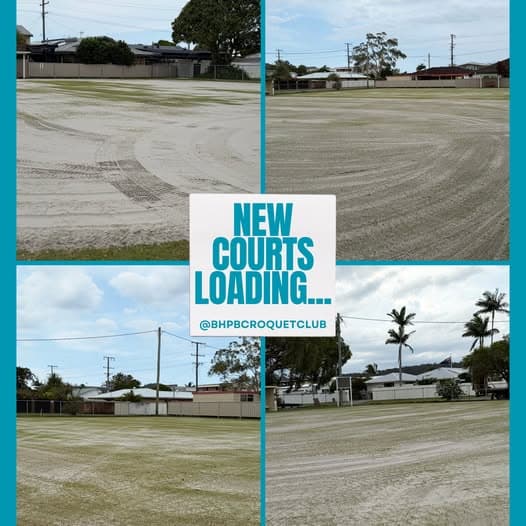
Burleigh Heads Palm Beach courts under renovation
The courts at Burleigh Heads Palm Beach are being renovated and will be back better than ever soon. Members are thanked …