How croquet is played, ahead of Nambour's lawn opening
(CONTRIBUTED) Opening of the two new lawns and club house of the Nambour District Croquet Club on Saturday, May 30, will enable the public to better appreciate the game when it is being demonstrated…
C(ONTRIBUTED)
Opening of the two new lawns and club house of the Nambour District Croquet Club on Saturday, May 30, will enable the public to better appreciate the game when it is being demonstrated on that occasion by leading players of Queensland. To generally create interest in this further local amenity, this and a subsequent article on croquet—the acknowledged second most scientific of games, is made available by a local exponent.
Croquet may be played as "doubles" when each player of a side is required to make 13 points (run six hoops twice and hit the centre peg) 26 points for the partners; or as "singles" when the player is required to make 13 points with each of the two balls he plays. In either case the red and yellow balls are partners, opposing blue and black. In social games more than one game is played on a lawn at the one time, and, to avoid confusion, a "doubling-up" set is used, i.e., pink and white opposing brown and green. The hoops have to be run from the correct side and in order. When the six hoops have been run, the return course requires them to be made from the opposite side in order, and the hitting of the centre peg completes the 13 points.
To make these points the player works off the other three balls of the set by first roqueting (hitting on to) a ball, then placing his own ball against the roquetted ball and taking two croquet shots therefrom, either to get position to run a hoop with the first shot and run the hoop with the second, or to roquet a second ball and/or the third ball with the same objective. If he is unable to run a hoop after working off the three balls, or if he fails to roquet a ball, his turn ceases, and the opposing side come into play. The incoming player or players may play whichever of their own two balls it is to their advantage to play. Should, however, a player be successful in running a hoop in order, he is then qualified to reuse the three remaining balls of the set in an endeavour to make the following hoop in order—that is why a player never endeavours to run a hoop unless he has a ball close handy to roquet thereafter and carry on. In this way, and by the use of the various types of croquet shots carrying forward for further use balls as used, the player may make what is termed "a break" and make as many as 13 points in one turn for his own ball and, by peeling his partner ball through hoops in order, as opportune, make additional points for the side at the same time.
It is essential, as well as to make points, to endeavour to leave your opponent's balls separated by distance or obstacle (hoop or peg, termed "wiring") so that he has to depend on a long shot to roquet and get in to play; and to this end a player will often consider it inadvisable to try a doubtful roquet or hoop-running shot, but rather return to his partner's ball and lay-up for a subsequent turn. The end of a turn may also be determined by a ball going to the boundary line on a croquet shot, or by committing a "foul" as laid down in the rules.
A clip corresponding in colour to each ball is fastened by a player to the top of the next hoop in order that ball has to run. On the return course, the clips are placed on the side of the hoop. By this means, the position of the game is obvious to all players and onlookers, without query; and a player would refrain from leaving an opponent's ball in front of its hoop, but endeavours to obtain such a position for his own, or lay a drive thereto. A ball going to the boundary is placed on the yard-line, directly in from the spot it crosses the boundary.
Next article—"Strokes and shots in croquet."

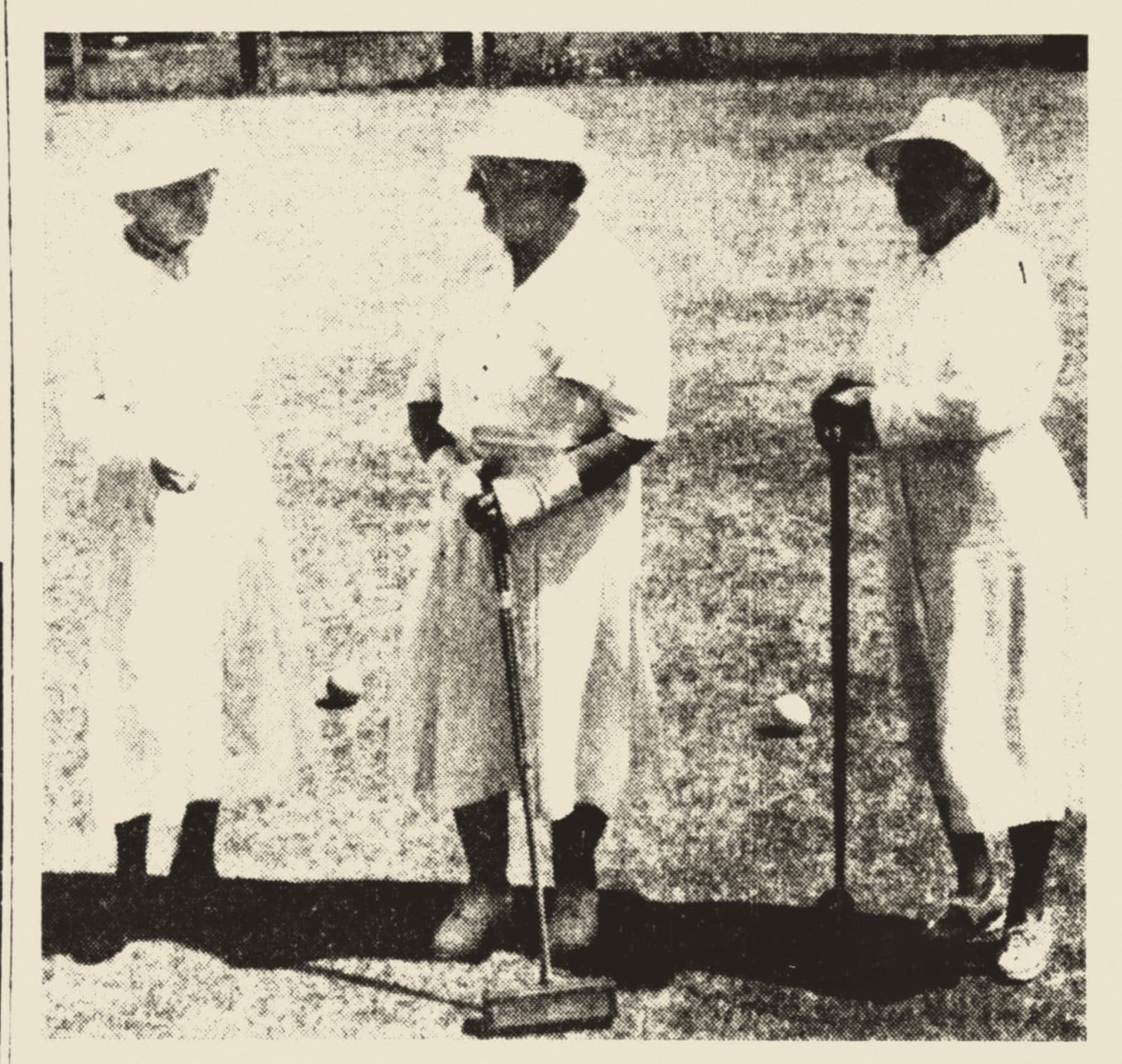
The article as it was printed in Nambour Chronicle, 15 May 1953. Scan from Trove, National Library of Australia. (Trove, National Library of Australia)

Get HOOPLA! in your inbox
Topics
The 4000 Years of History Project
I am collecting club history and old pictures into the history library on HOOPLA!. Fourteen clubs already have old newsp…
Twilight croquet under lights for Rotary clubs
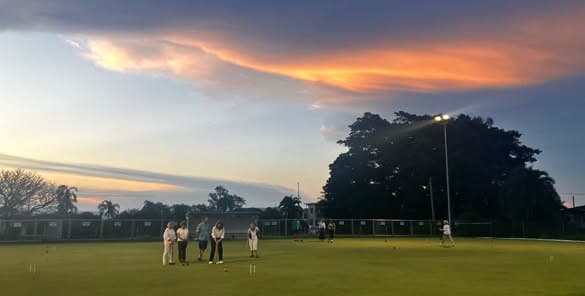
Stephens hosted Rotary Club of Brisbane High-Rise and Rotary Club of Paddington for twilight croquet under lights last S…