Ipswich Croquet Club opens its new pavilion
"The erection of our club house has entailed a considerable amount of unselfish work and co-operation from members, especially as it was only about 12 weeks ago that the suggestion for its erection…
Q&uot;The erection of our club house has entailed a considerable amount of unselfish work and co-operation from members, especially as it was only about 12 weeks ago that the suggestion for its erection was first made," remarked the President of the Ipswich Croquet Club (Mrs. M. W. Haenke) yesterday, having introduced the Mayoress (Mrs. A. T. Stephenson) to members and visitors at the official opening of the new croquet club house. "We appreciate the generosity of the council in granting us the increased area of land, without which the project could not have been undertaken. I desire to thank all the members, their husbands, those who formed a working bee, and friends who have assisted so willingly towards the completion of our pavilion," concluded Mrs. Haenke.
Before declaring the pavilion officially open, Mrs. Stephenson congratulated the club upon its wise step. "It marks a new era in the progress of the club," said Mrs. Stephenson, "and after surmounting many difficulties it marks a definite keynote of optimism for the future." Mrs. Stephenson referred to the pioneers of the Ipswich club and their enthusiasm. This same spirit was evidently being carried on, positive proof being in the realisation of the cosy and beautiful pavilion, where she trusted many happy hours would be spent and the future of the club would be assured of success. Mrs. Stephenson also congratulated the winners of the B-grade pennant. The pavilion was then declared open, Mrs. Stephenson unlocking the door and entering with a bouquet presented to her by the Patron of the club (Mrs. H. T. Hooper).
On behalf of the members Mrs. J. T. Millar thanked Mrs. Haenke for the wonderful work she and her husband had put into the building and their generosity in many ways.
Another pleasant ceremony was the unfurling of the B-grade pennant, which was performed by the President of the Queensland Croquet Association (Mrs. S. Sowden). Introducing Mrs. Sowden, Mrs. Haenke spoke of her pride in the winners, Mesdames W. Rossow, J. W. Aspinall, R. W. Lees, and E. B. Johnson.
Congratulating the winners, Mrs. Sowden said she was always pleased to see young players come forward and thought it only right that the old players should give them encouragement and help. She spoke of the prowess of Ipswich players and specially mentioned Mrs. S. H. Harding, who won the British gold medal in 1924, Mrs. E. Lewis who won the silver medal in 1926, and Mrs. F. W. Woodward, winner of the silver medal in 1931. "The Ipswich players are well-known," smilingly remarked Mrs. Sowden. "They mean to win and they usually do." The flag was then unfurled to the accompaniment of enthusiastic applause. A bouquet was presented to Mrs. Sowden, each of the pennant winners receiving a flat posy of pansies and maiden-hair fern.
Mrs. Hooper moved a vote of thanks to the visitors, which was seconded by the Senior Vice-President (Mrs. H. Parkinson).
Afternoon tea was served in the pavilion, Iceland poppies, gerberas, and poinsettia making a gay spectacle. Grouped in the centre of the room were several seagrass lounge chairs, around a table of beautiful flowers of all descriptions. It was a most artistic setting to the charming room.
Throughout the afternoon croquet competitions engaged everyone's attention, the winners being: Gymkhana, Mrs. F. Vincent; crazy, Mrs. D. L. Davis, Brisbane; target, Mrs. R. P. Watson; angle, Mrs. R. Penrose; bell, Mrs. J. B. McCullough.
A lively trade was carried on at a cake, sweets, and produce stall conducted by Mesdames A. Haenke, F. G. Woodward, and N. Kippen, and at a work stall controlled by Mesdames R. W. Lees and W. A. Foote. Members in charge of the competitions were: Mesdames M. K. Carmody, T. H. Millar, E. B. Johnson, W. Rossow, T. Barnes, Johnstone Smith, W. Miller, J. C. Minnis, A. Walker, W. Pohlman, and B. Jeffery.
In the large attendance were Mesdames M. W. Haenke, H. T. Hooper, J. A. Elliott, H. Parkinson, A. R. Walker, F. G. Woodward, J. T. Millar, A. Haenke, F. Williams, J. W. Aspinall, Johnstone Smith, E. B. Johnson, T. H. Millar, P. A. Barbat, E. Lewis, W. Pohlman, R. W. Lees, H. H. Holmes, B. Jeffery, T. H. E. Palmer, M. K. Carmody, W. Rossow, G. B. Reason, J. F. Walker, N. Kippen, T. Barnes, J. Wood, W. A. Foote, A. Walker, W. Miller, J. C. Minnis, F. G. Holmes, J. McDougall, Mesdames T. Nimmo and G. H. Milne (Graceville), D. B. McCullough (President), S. Dexter, D. L. Davis, R. Penrose, A. Collinson (Treasurer, Q.C.A.), Coxen, A. W. Isaacs, McIntyre, Misses I. Kelly and Chambers (Merthyr), A. K. Lawson, F. Burnett, Smith, A. Fraser, C. Roden, and Fred. Robinson (McIlwraith), R. J. Chalmers, H. G. Simpson, D. Muller, M. Bowers, F. T. Hooper, H. A. Denny, W Sherman, J. B. Singleton, G. Phillips, H. G. C. Williams, W. J. Rawlings, C. A. Preston, Cumming, S. C. Cuerel, Calder, H. Reilly, Headridge, H. Williams, H. J. Bassett, R. P. Watson, C. Hunt, T. H. Parker, V. G. Noble, E. W. Haenke, L. Foote, R. Hunter, Parsons (Victoria), B. Taylor, B. F. Smith, F. W. Turley, G. S. Stephenson, C. E. Greenham, C. W. Shenton, A. G. Thomas, L. J. Middleton, R. Wilkinson, W. H. Forbes, C. F. Barnes, G. Senior, F. Cooper, T. D. Meares, O. Boettcher, C. Walters, P. K. Elkes, D. Logan, R. Sellars, F. C. Downes, E. J. O'Keeffe, J. J. Petford (Corinda), H. Ferrett, D. Bedford, W. Meyer, E. J. Hatton, Penrose (Brisbane), J. Trickett, Baron, J. B. Lewis, H. M. Walker, J. J. Dodd, J. P. Neal, L. Campbell, G. Mathieson, J. J. Sheppard, J. Culliton, Misses C. Watson, J. Tatham, E. Hooper, B. Barbat, L. Parkinson, D. Barnes, C. J. McLeod, M. Aspinall, T. Livermore, S. Goodwin, Parker, L. James, M. Flannagan, M. Broughton, White, Petford (Corinda), N. O'Connor, A. Hooper, E. Ferrett, F. Young, L. Handley, and E. Mathieson.
The new club house is a fine modern structure, and is much more commodious than the old building. From outside and inside it looks most imposing, and it is a tribute to the hard work and ambition of the club members. The building measures 50ft. by 30ft., but the main portion, which is 44ft. by 30ft., will be used as a meeting place, for dancing, and other functions. The external walls are of hardwood weatherboard, while the partitions are of dressed pine. The walls are panelled with three-ply, stained half way up, and the covered ceilings are panelled fibro-cement. Seats have been provided all round the main room for the comfort of members. The kitchen has been enlarged, electric lights have been installed, and a modern septic system is provided. There are casement windows on the northern, southern, and eastern sides, with louvres on the western side. Mr. M. W. Haenke was the architect, and Mr. E. Neumann the contractor. Sub-contractors were Messrs. J. Cuthbert (plumbing), Edwards (electric light), Thompson (painting), and A. Foote (joinery).

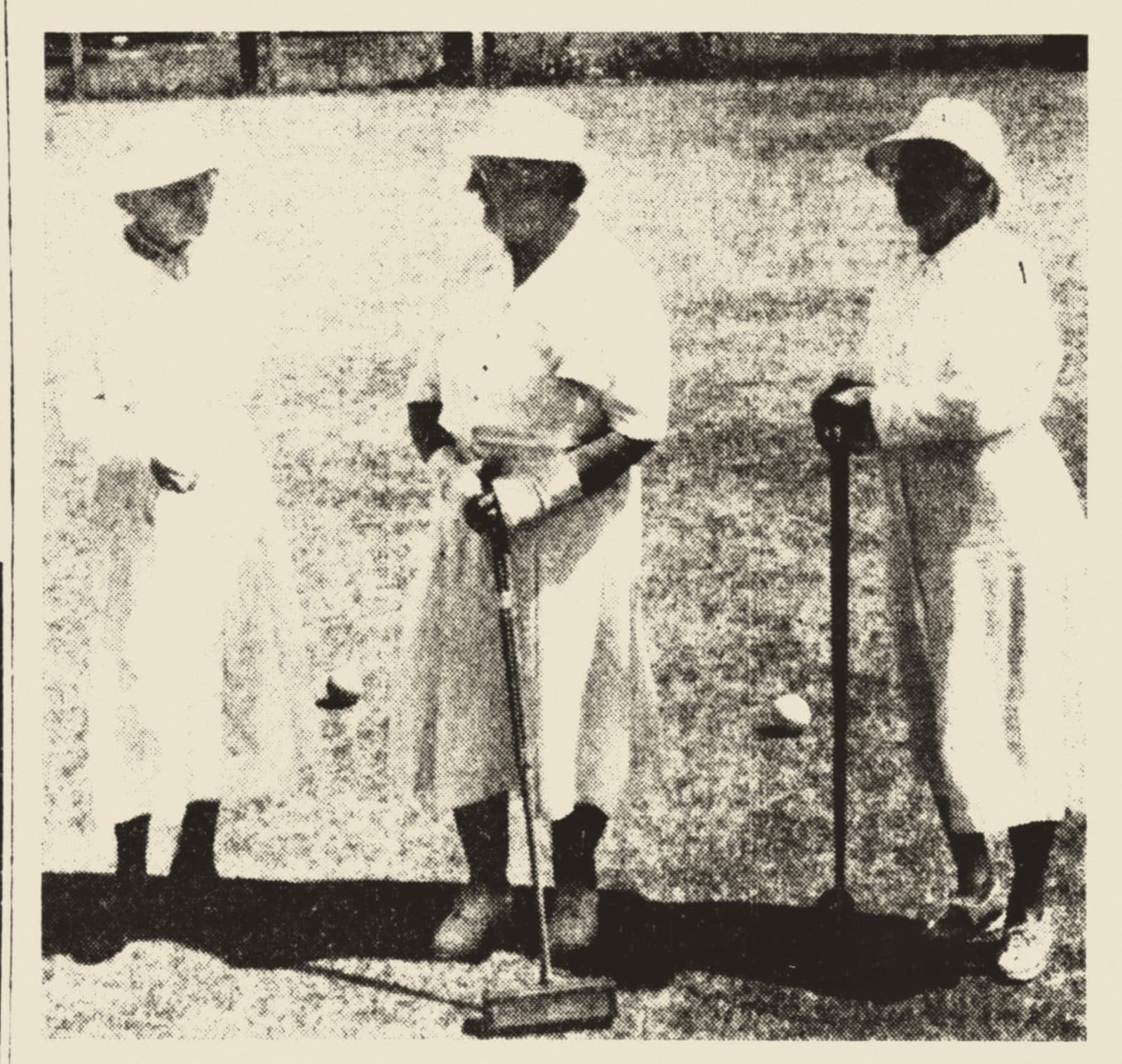
The article as it was printed in Queensland Times, 4 August 1933. Scan from Trove, National Library of Australia. (Trove, National Library of Australia)

Get HOOPLA! in your inbox
Topics
The 4000 Years of History Project
I am collecting club history and old pictures into the history library on HOOPLA!. Fourteen clubs already have old newsp…
Twilight croquet under lights for Rotary clubs
Stephens hosted Rotary Club of Brisbane High-Rise and Rotary Club of Paddington for twilight croquet under lights last S…