East Brisbane Croquet Club history, Part 2
Part 2 of the East Brisbane Croquet Club story looks at changing membership, fundraising and the challenges the club has faced. It credits members' tenacity for 114 years of play.
AST BRISBANE CROQUET CLUB – Part 2

At the time the club was founded on 1 November 1905, women were expected to be homemakers and few were able to take up paid positions until WW1. Marriage meant that working women had to stop work. This did not change until the late 1960s, and it was not until 1966 that married women could hold permanent positions in the public service.
It is not surprising, then, that the EBCC was a ladies-only club until the 1970s, when men first joined, initially enabling couples to play together. The first male vice president was elected in 1985 and the first male president, Doug Williams, in 1999. He is still the current president.
Membership has always been a major issue, with gradually decreasing numbers (in 1962 membership was only 26) and again in the 1980s and 1990s. This required members to come up with more creative ways of fundraising and promotional events to encourage new members. For a while golf croquet events, bridge and mahjongg clubs based at the club helped, but finances continued to be a struggle.
When the club became incorporated on 13 April 1991 it had only 27 financial members. Intensive club promotion continued. In 1992 a prominent CROQUET sign was erected on the fence adjacent to the ferry carpark. Incorporation also gave access to a variety of grants which helped the club to improve and update its facilities, e.g. watering system, storage shed, spectator facilities, clubhouse etc.
It is the club's strong focus on friendship, collegiality and support which helped keep it functioning despite these constant challenges. As well as dealing with ever-increasing costs for court maintenance, greenkeeper wages, fertilisers and other expenses, they had to cope with several cases of vandalism and break-ins. Despite all valiant efforts by members, numbers continued to drop and by 2001 there were only 8 active members.
New strategies such as hiring out the facilities (introduced in 2004) and hosting croquet titles have helped keep the club going.
However, it is the passion, dedication, hard work and tenacity of many members which has enabled the club to continue to exist for 114 years. Hopefully it will continue for many years to come; it deserves the support of local communities and authorities.
(Source: Trove / Rechner, Judy Gale: East Brisbane Croquet Club, 100 years)

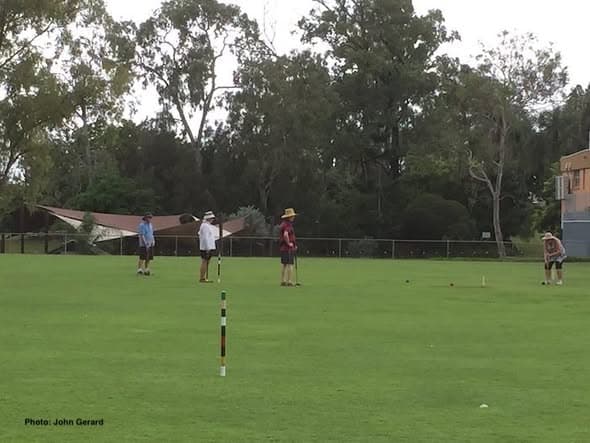
Photos
Get HOOPLA! in your inbox
West Toowoomba's Friendship Day draws 36 players, and a grandmother coaches a budding champion
West Toowoomba Croquet Club held its annual Friendship Day on Thursday, with 36 players enjoying themselves despite tric…
All the different types of Queensland's croquet club logos
You'd think there are only so many ways to draw a mallet, yet all our clubs' logos look nothing alike.