New Study In The Lancet Suggests Only 7,000 Steps Are Needed a Day. Get Them With Croquet.
A major new study in The Lancet reveals that 7,000 steps a day can lower all-cause mortality risk by 47%. Croquet is the perfect way to achieve this goal.
ou've heard the 10,000 steps rule. New research says you can ignore it.

For years, that number has made daily walking feel like a chore. You check your phone, see 4,000 steps, and feel like you've failed. The goal seems built for marathon runners, not people looking for sustainable exercise in their 60s and 70s.
[image: Croquet players on a sunny lawn -- https://imagedelivery.net/IEMzXmjRvW0g933AN5ejrA/assetsbulletsitefiles-23b5a74c-8df0-80ea-9ba4-e15771cefdf7-attachment922e4dc0-1c58-4490-9253-ba90a74052fdcovertifjpg/public]
A 2025 meta-analysis in The Lancet Public Health analysed 57 studies from around the world. The finding: 7,000 steps delivers most of the benefit.
"Although 10000 steps per day can still be a viable target for those who are more active, 7000 steps per day is associated with clinically meaningful improvements in health outcomes and might be a more realistic and achievable target for some." (Source: The Lancet Public Health, 2025)
[image: Graph showing health benefit vs step count -- https://imagedelivery.net/IEMzXmjRvW0g933AN5ejrA/assetsbulletsitefiles-23b5a74c-8df0-8060-a565-f5973c32f646-attachment27ebf486-1154-44ca-a73a-2c9ab5be72d8072325_sw_steps_inlinedesktop-scaledwebp/public]
The study tracked nearly 50,000 people across four continents. For adults over 60, most of the benefit comes between 6,000 and 8,000 steps per day.
This graph from the study shows it clearly: the steepest drop in health risk (the "Hazard ratio") happens in the first several thousand steps, with the benefits levelling off around the 7,000-step mark. (Source: Paluch et al, The Lancet Public Health, 2022)
The numbers are striking. Compared to 2,000 steps per day:
According to the meta-analysis, hitting that 7,000-step mark was associated with a 47% lower risk of all-cause mortality. It was also linked to a 47% lower risk of cardiovascular disease mortality and a 25% lower risk of cardiovascular disease incidence.
Getting your steps without counting them
The challenge with step targets is sticking to them. Walking laps around a shopping centre or pacing a treadmill works for some people. For others, it gets old fast.
Croquet is a different approach. You get your steps as a side effect of doing something you actually want to do.
[image: Croquet player on lawn -- https://imagedelivery.net/IEMzXmjRvW0g933AN5ejrA/assetsbulletsitefiles-23b5a74c-8df0-8039-82c5-c9a5c40cccc0-attachment9600e46c-6335-4f03-85de-1907c2d2f36af6a72c64-c1e3-4d2d-a4f8-8752aeaeaa60jpg/public]
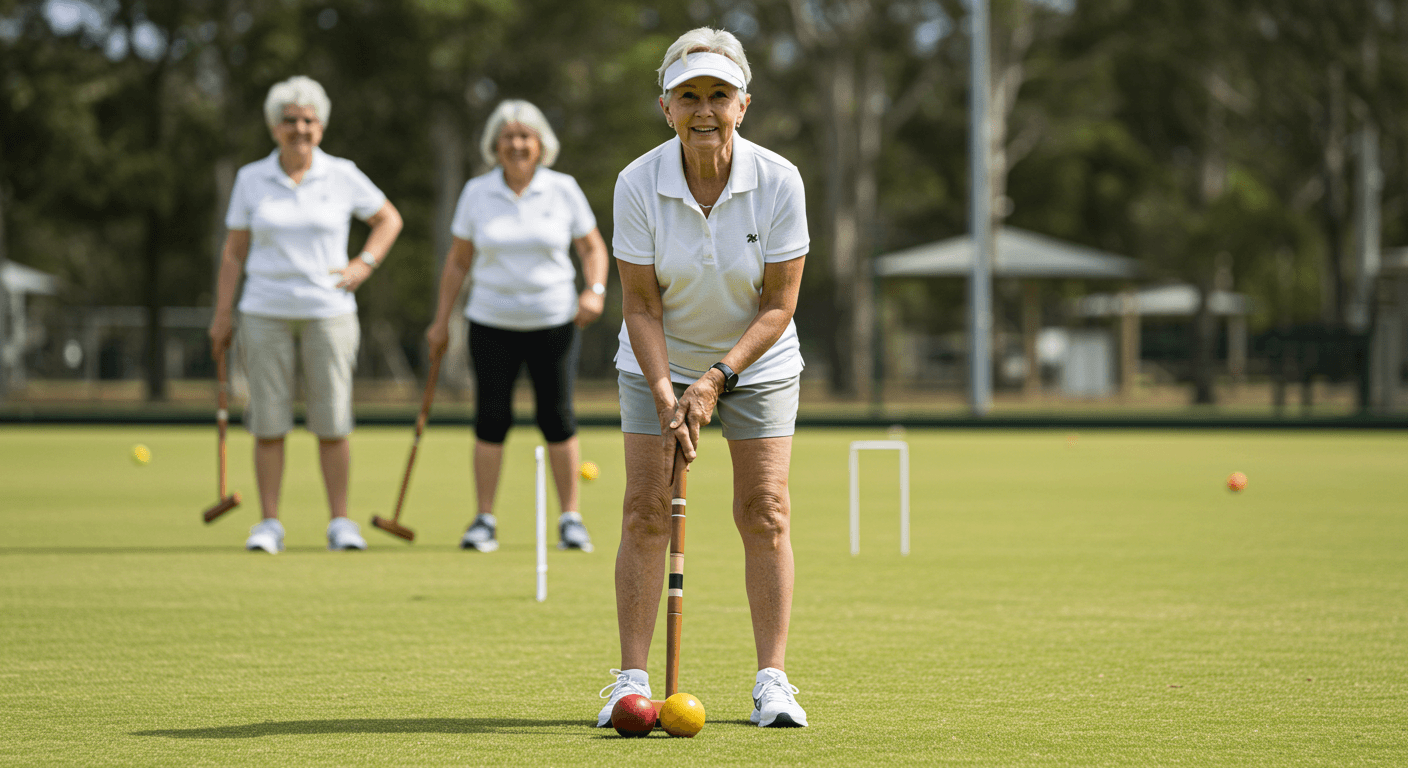
Over two to three hours on the lawn, players walk to their ball, circle the court, position for the next shot. A typical game covers three to four kilometres, or 5,000 to 7,000 steps.
How does that compare?
- 30-min neighbourhood walk: 3,000–4,000 steps. You're thinking about how many more minutes.
- 1 hour on a treadmill: 5,000–6,000 steps. You're watching the TV on the wall.
- Golf (18 holes, no cart): 8,000–10,000 steps. You're thinking about your swing.
- Croquet (2–3 hour game): 5,000–7,000 steps. You're thinking about whether you can make that hoop.
The steps are similar. The experience isn't.
You don't notice because you're thinking about the game. Where should I put my ball? Can I get through that hoop? What's my opponent planning? The walking happens while your mind is somewhere else.
There's also the social pull. Croquet is played at clubs, with the same people, on regular days. You show up on Wednesday because you said you would, because there's morning tea afterwards, because people notice when you're not there. That consistency is what makes it work long-term.
The Lancet study looked at a wide range of outcomes:
"This study examines the prospective dose-response association between daily steps and a wide range of health outcomes, including all-cause mortality, cardiovascular disease incidence and mortality, type 2 diabetes incidence, cancer incidence and mortality, dementia, depressive symptoms, physical function, and falls." (Source: The Lancet Public Health, 2025)
You don't need to hit 7,000 to see benefit. Every increase helps.
[image: Croquet players enjoying the game -- https://imagedelivery.net/IEMzXmjRvW0g933AN5ejrA/assetsbulletsitefiles-23b5a74c-8df0-801c-814b-c4fc7efe21cb-attachmenta2dcf4ce-02f2-4290-b684-95de2c37ee3e5a3f372c-033d-4871-895e-fb629d84489fjpg/public]
"Importantly, even a modest step count was associated with lower risk. For example, 4000 steps per day compared with 2000 steps per day was associated with substantial risk reduction, such as a 36% lower risk in all-cause mortality." (Source: The Lancet Public Health, 2025)
Why this matters after 60
The Lancet data is clear: for older adults, the benefit curve flattens earlier. You don't need 10,000 steps. You need movement you'll actually do, week after week, for years.
Croquet fits that. It's low-impact enough that joints can handle it. It's engaging enough that you want to come back. And it builds in the social connection that keeps people accountable.
If walking for the sake of walking hasn't worked for you, try walking for the sake of winning.
Find a club near you at comeandtrycroquet.com

Get HOOPLA! in your inbox

Bribie Island's doubles final goes all the way to the last hoop
Bribie Island Croquet Club's October news: a doubles final won at sheep station, Steve Bickley 8th at the GC Nationals, …
No need to sign in to play
Registered players don't need to sign in. Only visitors and overseas players must be recorded.