Croquet in Queensland (History)
If you're joining a Queensland croquet club, you're not just stepping onto a lawn—you're becoming part of a tradition that reaches back more than 170 years.
roquet has been played in Brisbane since 1865. That year, Brisbane's first croquet ground was laid out in the Botanic Gardens. It was the same year Lewis Carroll published *Alice's Adventures in Wonderland*, with its famous game of croquet.

Croquet was a game men and women played together. In August 1911 the South Brisbane Croquet Club held a tournament at Musgrave Park. It included a doubles game in which two women played two men, and a good crowd of spectators came to watch. A photograph of a 1911 tournament at Musgrave Park shows everyone in formal attire.
In 1922 the Queensland Croquet Association was formed. It later became the Croquet Association of Queensland, or CAQ. The new name was chosen to avoid confusion with the Queensland Cricket Association.
By the 1930s croquet was played across the state, from Brisbane to Kingaroy, where a ladies croquet club was formed in 1931. Today CAQ has 41 affiliated clubs in Queensland and northern New South Wales. Five of them show how the game grew.
McIlwraith was founded in 1923. It sits on land that Lady Harriett McIlwraith gave to the Toowong Town Council in 1911. She was the widow of Sir Thomas McIlwraith, three times Premier of Queensland.
The first meeting to form the club was held on 24 September 1923. On Saturday 19 July 1924 the Mayor of Toowong, Alderman A. Watson, officially opened the club. Afternoon tea was served at tables "decked with bowls of poinsettia, gerberas, arum lilies and coleus leaves."
The club stands over the filled-in pond of the old Auchenflower estate. It has recovered from repeated floods since 1931.
Stephens also began in 1923. On 15 October that year Mr F. Stimpson, Chairman of Stephens Shire Council, arrived at Yeronga Park with a horse and plough to prepare the ground. His wife became the first president, and the club started with 18 members.
For decades the members were women. Men were admitted as players some time before 1976. The club had its own standards too: in the 1950s, the wearing of dark coloured cardigans was banned.
Stephens also knew hard times. The Great Depression left the club in debt to its founders right through the 1930s. In 1940 money was so tight that the club stopped paying the tea lady, and members brought their own afternoon tea. Better days came. In the 1980s Stephens hosted state and national events and earned a reputation for the high quality of its lawns.
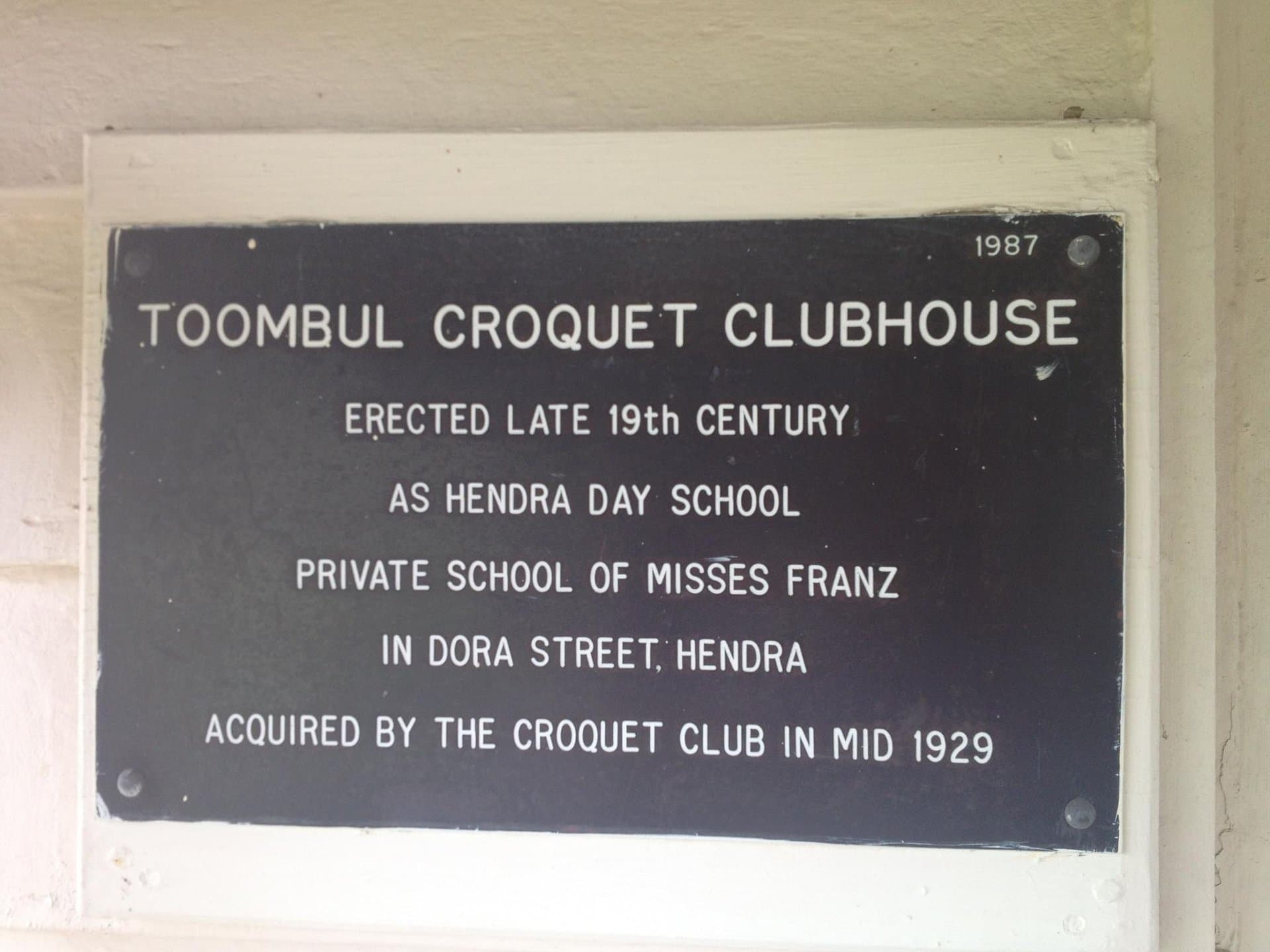
Toombul was founded in August 1928 at what is now Oxenham Park, Nundah. In 1929 the club found itself a clubhouse in an unusual way. It moved a former schoolhouse onto the site. This was the Hendra Day School, the Misses Franz's private school in Hendra, which had closed in 1928.
Southport was founded in 1935. Back then, the Gold Coast was "a sleepy seaside town of just a few thousand people, and a loaf of bread cost only a few pence." It began as a women-only club. Men joined in the 1960s, "though they had to buy their own cup of tea for five cents!" Today Southport is Queensland's largest club, with nearly 100 members.
Laurel Bank in Toowoomba has played in Laurel Bank Park since 1934. Samuel George Stephens, known as "the man of flowers", gave the park to the people of Toowoomba in 1932. He asked that it not become a sports ground, with one exception: the croquet greens. Every year 70,000 to 80,000 annuals and 11,000 bulbs are planted there for spring.
Not every story survives. Most of Windsor Croquet Club's records were lost in the 1974 flood.
The game itself has changed. For most of the 20th century, Association Croquet was the only game played. Stephens first mentions Golf Croquet in its records in 1987. Queensland clubs now play four codes: Association Croquet, Golf Croquet, Ricochet and Gateball.
Every new member joins a club with a long history behind it. Clubs were built on ploughed ground and gifted land, kept going through debt and floods, and shared many cups of tea along the way.

Get HOOPLA! in your inbox
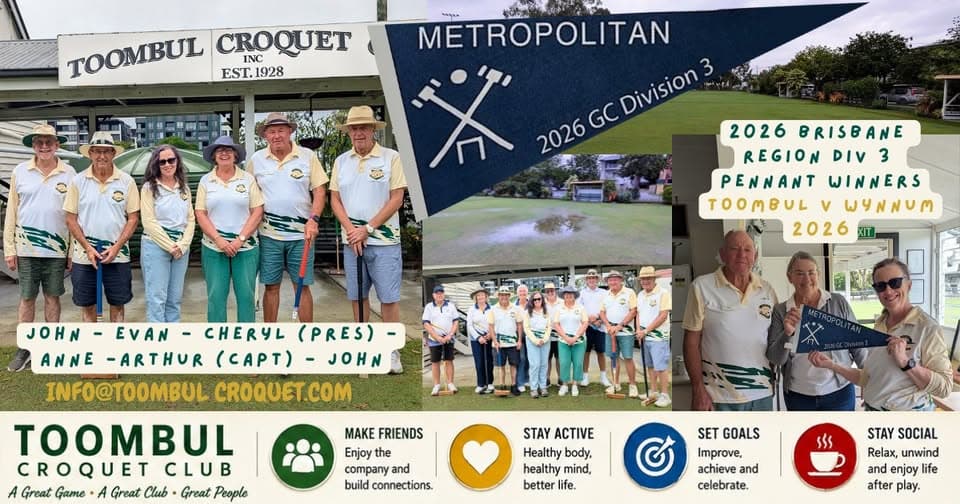
Toombul wins Brisbane Division 3 Pennants Final
Toombul, the Northside winners, beat Wynnum 7 games to 3 in the Brisbane Division 3 Pennants Final. The club congratulat…
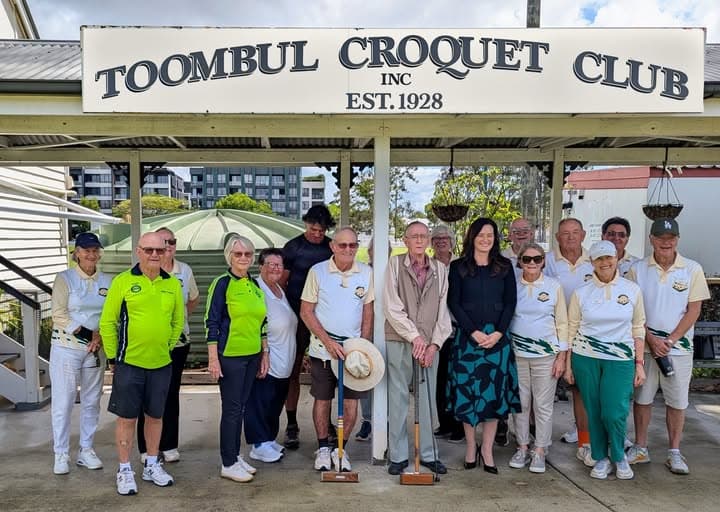
Lindsay Boaler wins Toombul Golf Croquet Championship; Patron Leanne Linard visits
Lindsay Boaler won the Doherty shield with a 7-6 final against a field of 16 players. Patron Leanne Linard also joined a…